Using community conversations to improve men's access to HIV services
© Peter Strauli for the Manicaland HIV Project
One of our qualitative studies found that people in Manicaland reported a clear notion of what it means to be a 'real man'. Men in this context are required to be and act in control, to have know-how, be strong, resilient, disease free, highly sexual and economically productive. However, such traits were in direct conflict with what it means to be a HIV patient on ART - who is expected to accept being HIV positive, take instructions from nurses and engage in health-enabling behaviours such as attending regular hospital visits and refraining from alcohol and unprotected extra-marital sex. This conflict between local understandings of manhood and understandings of ‘a good patient’, we believe, provide a possible explanation to why so many men do not make use of HIV services in Zimbabwe. However, we did find that once men had been counselled and had the opportunity to reflect upon the impact of ART on their productivity and social value, it was possible for some to construct new and more ART-friendly versions of masculinity.
Acknowledging that notions of what it means to be a man in any given context is socially constructed, and to develop more ART friendly and health-enabling masculinities, we decided to provide community groups with social spaces to debate, discuss and renegotiate new undestandings of what it means to be a man.
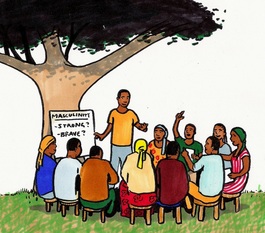
Between January and May 2011, members of the Manicaland Project facilitated 20 community conversations with men and women from various types of community groups. The community conversations were facilitated using a booklet, which contains key questions that encourage the participants to enter into a dialogue about socially constructed masculinities and their impact on HIV service use.
Acknowledging that notions of what it means to be a man in any given context is socially constructed, and to develop more ART friendly and health-enabling masculinities, we decided to provide community groups with social spaces to debate, discuss and renegotiate new undestandings of what it means to be a man.
Between January and May 2011, members of the Manicaland Project facilitated 20 community conversations with men and women from various types of community groups. The community conversations were facilitated using a booklet, which contains key questions that encourage the participants to enter into a dialogue about socially constructed masculinities and their impact on HIV service use.